by Daniel Conrad Jones (Email)
Copyright 2017 © Daniel Conrad Jones
Another version of this article was published in Southern New Mexico Historical Review XXIV, no. 1 (2017), pp. 35-44.
The author gratefully acknowledges the research help of Charles "Butch" Sanders, who provided much material on the Crees and Brandon Kirby.
|
LINKS: |
Dedication
to Cal Traylor
1924—2015
Cal and I were both members of the Billy the Kid Outlaw Gang. In July 2014 their meeting was held in Silver City and vicinity. While we were taking a tour of Ft. Bayard, Cal came up to me and introduced himself. Somehow he knew that I was from Ruidoso. He passed me a Friends of Pat Garrett card. And he said “I am trying to find where Pat Garrett lived in the Alto area”. I said “Sure, I’ll help with that”, thinking “I’ll just go to the courthouse and look it up.” It wasn’t nearly that simple. I did eventually find out, but it took me a lot longer than expected. In the process, I discovered, and became fascinated by, the Angus V V Ranch. Thanks, Cal. Our time together was much too short.
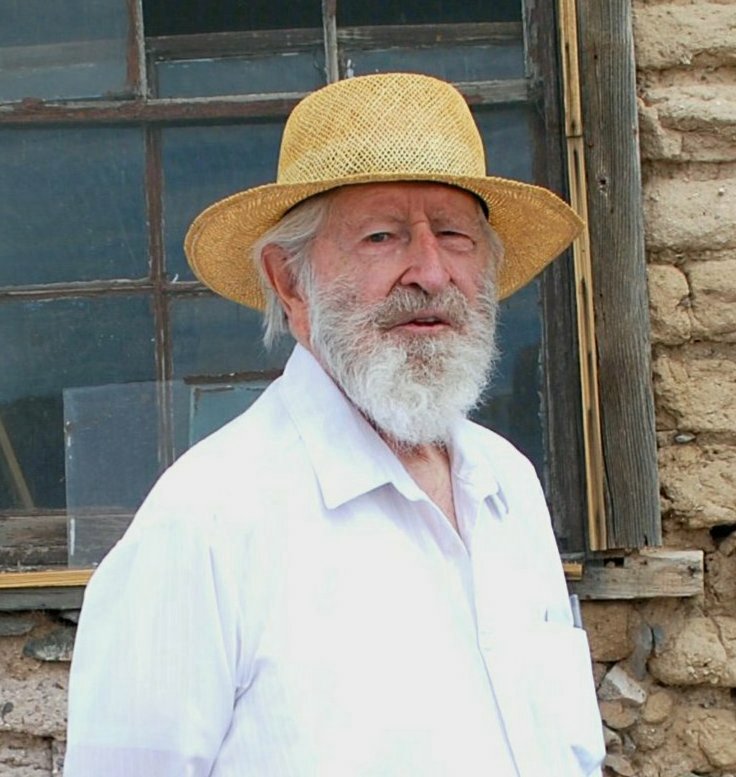
Cal Traylor (1924-2015)
Beginnings: 1880-1884
The V V had its genesis in the friendship of two men who came to southeastern New Mexico for the same reason. Cattlemen in the Pecos Valley, most notably John Chisum, were looking for a sheriff who could stop the depredations of Billy the Kid and his like on their cattle. They found their man in Pat Garrett, and, with the help of their sponsorship, he was elected sheriff of Lincoln County in November 1880. Likewise, cattlemen in the Texas Panhandle, most notably Charles Goodnight, were looking for a man who could stop the depredations of the Kid and his like on their cattle. They hired John Poe. Poe and Garrett met in White Oaks, at the time the biggest town in Lincoln County, and immediately became friends. Poe then had no official status. He was merely a private cattle detective. So Garrett proposed to deputize him, and Poe accepted.
There is no need here to go into the oft-told tale of the tracking and killing of the Kid. Poe continued afterward as deputy, but also in spring 1882 formed a ranching partnership with Francis (“Frank”) M. Goodin, with Poe as manager. He bought a couple of small parcels of land along Little Creek in present-day Alto, one for himself and one for Goodin. They called it the “V” Ranch; later changed it to “V V” for some unknown reason. But some long persisted in calling it just “V”.
Evidently the cattle business wasn’t entirely sufficient for Poe, so in fall 1882 he ran for Lincoln County sheriff, an office to which he was elected around November 7. Garrett had decided, as several others did, that he didn’t want another term, so Poe became his successor.
|
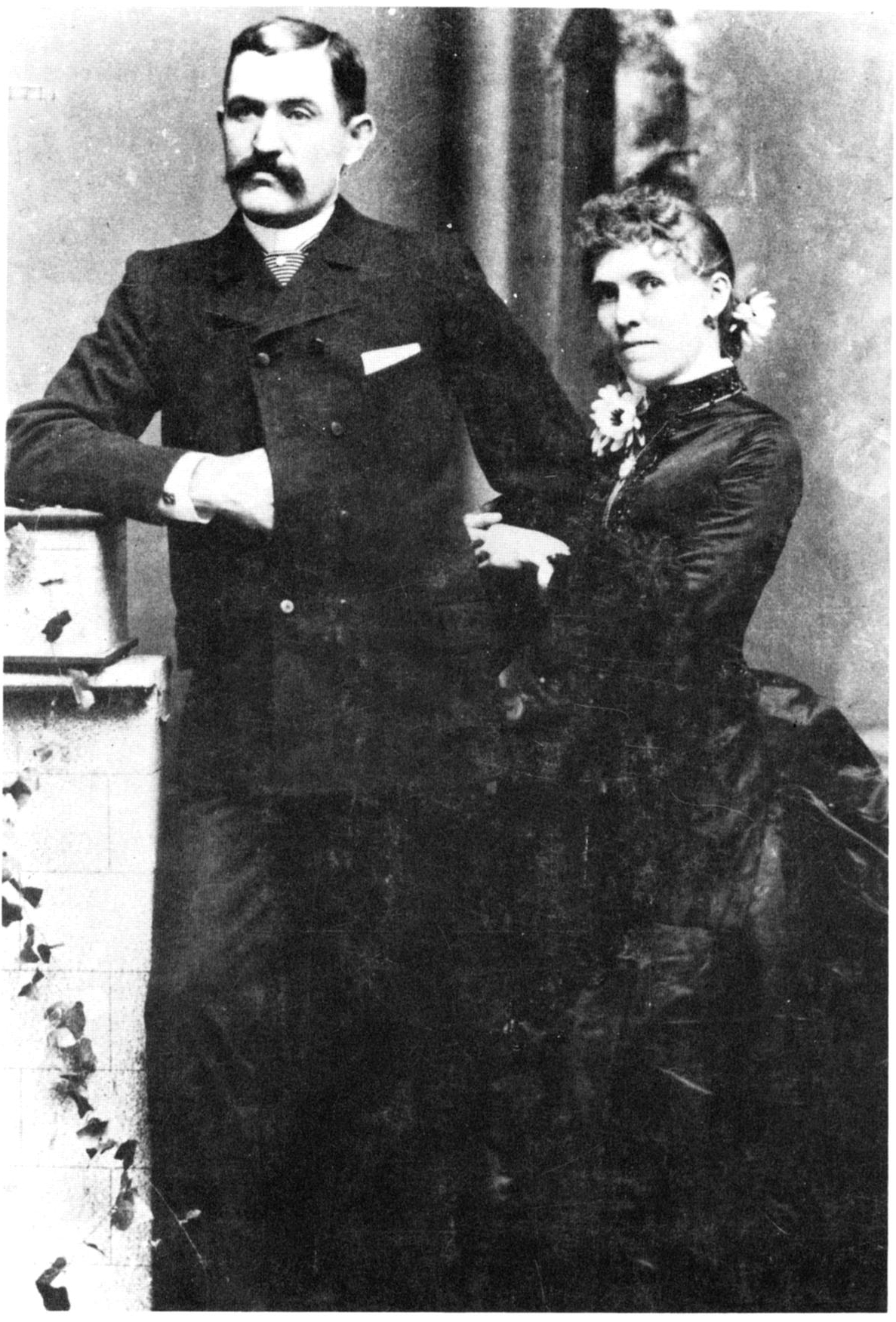
Another big change was soon to take place in Poe’s life. On May 5, 1883, he married Sophie Alberding. Sophie is important to our story because, after Poe’s death, she wrote a book called Buckboard Days, a description of her life with Poe in 1880s-1920s New Mexico. The book contains many details about the early days of the Ranch. For example, here she quotes Poe telling her why he called it the V V:
“I chose the V V brand because, while it’s simple, at the same time it’s hard to alter. Those are the two requisites in a good brand. Every cowman prefers a brand which can be made with a plain iron rod, for that saved carrying a heavy ‘stamp’ branding iron to make a special device. My cowboys can brand V V with four strokes of the running iron.” 1
|
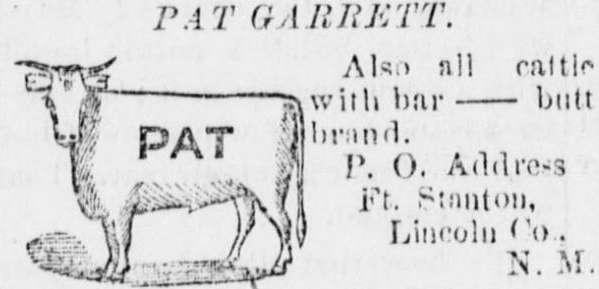
Garrett, too, started a small ranch, and for his brand he chose simply the letters “PAT.” Again according to Sophie, “Pat Garrett had a place up the [Little Creek] cañon, about the same distance [5 miles from the Poes’ cabin].”2 This ranch was exceedingly difficult for the author to locate, because Garrett never obtained a patent (the equivalent of a deed from the government) for the land. Likely he filed a homestead claim for it, but never “proved up” the claim, since he was gone long before he lived there for the 5 years required to do so. Unproven claims are only accessible by hands-on search at the National Archives in Denver.
In early spring of 1883, Garrett went to visit his cousin Seaborn T. Gray in Grapevine, Texas (near Dallas). He persuaded Gray to move his family to New Mexico to become his partner in the ranching business. They arrived there in September, and moved in with Garrett's family.3
Poe, in his first term as sheriff, found that Lincoln County lawlessness had not entirely abated with the death of the Kid.4 In spite of an “interesting” two years, he ran again and was re-elected around November 4, 1884.
Meanwhile, the ranchers in the Texas Panhandle were still having trouble with rustlers, so they called on Garrett. According to Leon Metz, “[Garrett’s] restless nature was not adjusted to raising cattle...”5, so he eagerly accepted the job of captaining a group of men to catch the rustlers. This group was variously called the LS Rangers (after the LS Ranch), the Home Rangers, or the LS Pat Garrett Rangers. Whether they were actually commissioned by the Texas governor, thus making them legitimate lawmen, is debatable.6
On December 27, 1884, Garrett left Alto7 to take his new job. He took with him his wife Apolinaria and newborn daughter Elizabeth (later to become known as the writer of the New Mexico state anthem O Fair New Mexico). He left his ranch in the custody of cousin Seaborn Gray. He left his family with relatives in Las Vegas, and continued on to the Panhandle.
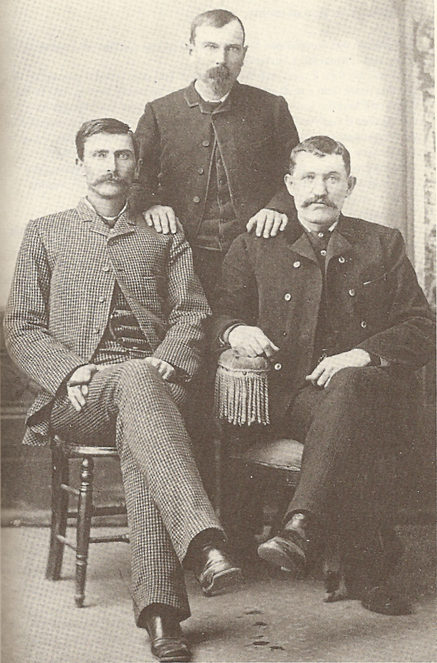
Pat Garrett (seated, left), John Poe (seated, right)
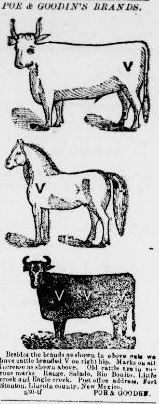
Poe & Goodin Brand Advertisement,
December 4, 1884
A busy year: 1885
Around May 25, 1885, an incident occurred which illustrates the problems with the government’s “open range” policy. Among Poe’s neighbors along Little Creek were a family named Breece: father Benjamin Lewis (known as B. L.), sons William Leander (known as Lee) and Adam, and assorted wives and children. Each of them had filed a homestead claim for land along the creek. They decided to go into the sheep business, and to that end brought in a herd of some 750. This was legal, as long as they kept to their own or government land. However, it greatly upset the cattlemen, notably Poe, Gray, and Goodin, because of their belief that sheep, when grazing, pull the grass out by the roots, thus killing it and ruining the pasture. Words ensued, and the situation escalated to the point where someone later fired some shots at a Breece shepherd. He wasn’t hurt, but nevertheless the Breeces went before a Justice of the Peace and swore out warrants against Poe, Goodin, Gray, and employees. They were duly arrested. The notion of Poe, the current Lincoln County sheriff, arresting himself seemed to amuse the Lincoln County Leader, which reported the story under the headline “Sheriff Poe Arrested – He Knows How it is Himself.”8
They were arrested on a Thursday, and tried the following two days. None were convicted. It might be tempting to regard this outcome as due to Poe’s influence (the Breeces’ descendants do). But in reading the facts of the case, it turns out that no witness knew who fired the shots. So the judge couldn’t reasonably have found otherwise.
Meanwhile Garrett, while working in the Panhandle, was traveling back and forth to Las Vegas frequently to see his family. On one of those trips, around July, he chanced to encounter Captain Brandon Kirby – an encounter that would have profound effects on the V V.
Kirby was a Brit, about 31 years old and single. He explained to Garrett that he was a member of a group of British investors who wished to buy land and establish a large ranch in North America. He had already been to Canada, but hadn’t seen anything of interest there. Garrett, sensing a business opportunity, brought him to Lincoln County to see Poe’s and other ranches in the area.
Kirby must have liked what he saw, because from then on things moved rapidly. By the end of August, Poe and Goodin, among many others, had contracted to sell out to Kirby. The Poes’ cabin was torn down for the materials to help in the building of the new headquarters.9
In the Panhandle, Garrett was upset about his job. He suspected that he had been hired to kill rustlers, not to bring them in for trial.10 An excellent opportunity to escape presented itself when Kirby offered him $5,000.0011 or $6,000.0012 per year to manage the V V, a huge salary in those days.13 He disbanded the Rangers and moved back to Alto around September 3, having captained them only about 8 months.
By September 10, Kirby’s fellow investors had arrived in Lincoln County. James Cree, 68, was a “wine merchant” from Edinburgh, Scotland.14 His wife Agnes was about 53, and their son James Edward was 21. Two other children, Margaret, 29, and William, 28, stayed in Scotland.
The Crees were very wealthy. They had both a townhouse in Edinburgh and a country estate, “Tusculum.” What motivated them to move to New Mexico when they were already elderly and rich is a fascinating topic for speculation. They retained their real estate, which still exists today, although it is no longer in the Cree family. William presumably remained in Scotland to manage the family businesses there.
There has been considerable confusion in the literature about which “James” is being referred to when describing a given event. Therefore, it should be understood that when the author says “Cree”, he is referring to the elder James unless otherwise stated.
|
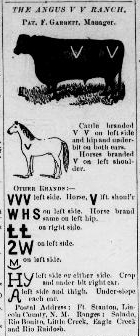
One of the first things Cree did after arriving in New Mexico was to register the “V V” brand to himself. Soon afterward, a newspaper advertisement appeared bearing the name “Angus V V Ranch”.15 This was the first known use of “Angus” prepended to Poe’s previous ranch name. This “brand ad” showed a Polled (lacking horns) Angus bull or steer, in spite of the fact that there were none there at the time.
Then, on September 26, Kirby contracted to sell all of the land he had purchased (2,443.64 acres) to Cree for $50,000. That amounted to around $20 per acre. What makes this peculiar is that he had bought that land only 1-2 months before, and had paid (for example) around $100 per acre to Poe and Goodin!
Was he just a poor businessman? What was the relationship between Kirby and Cree? Agent? Business partner? Adopted son? Prospective son-in-law? All of these have been proposed at one time or another by various people, some of whom knew them personally. If Kirby was Cree’s agent, then the September 26 deed can be explained by postulating that Kirby used Cree’s money, not his own, to purchase the land. The $20 per acre would then be a commission paid to Kirby, not the purchase price of the land. But if so, why did they do it that way? Alas, these questions must remain largely unanswered in this article.
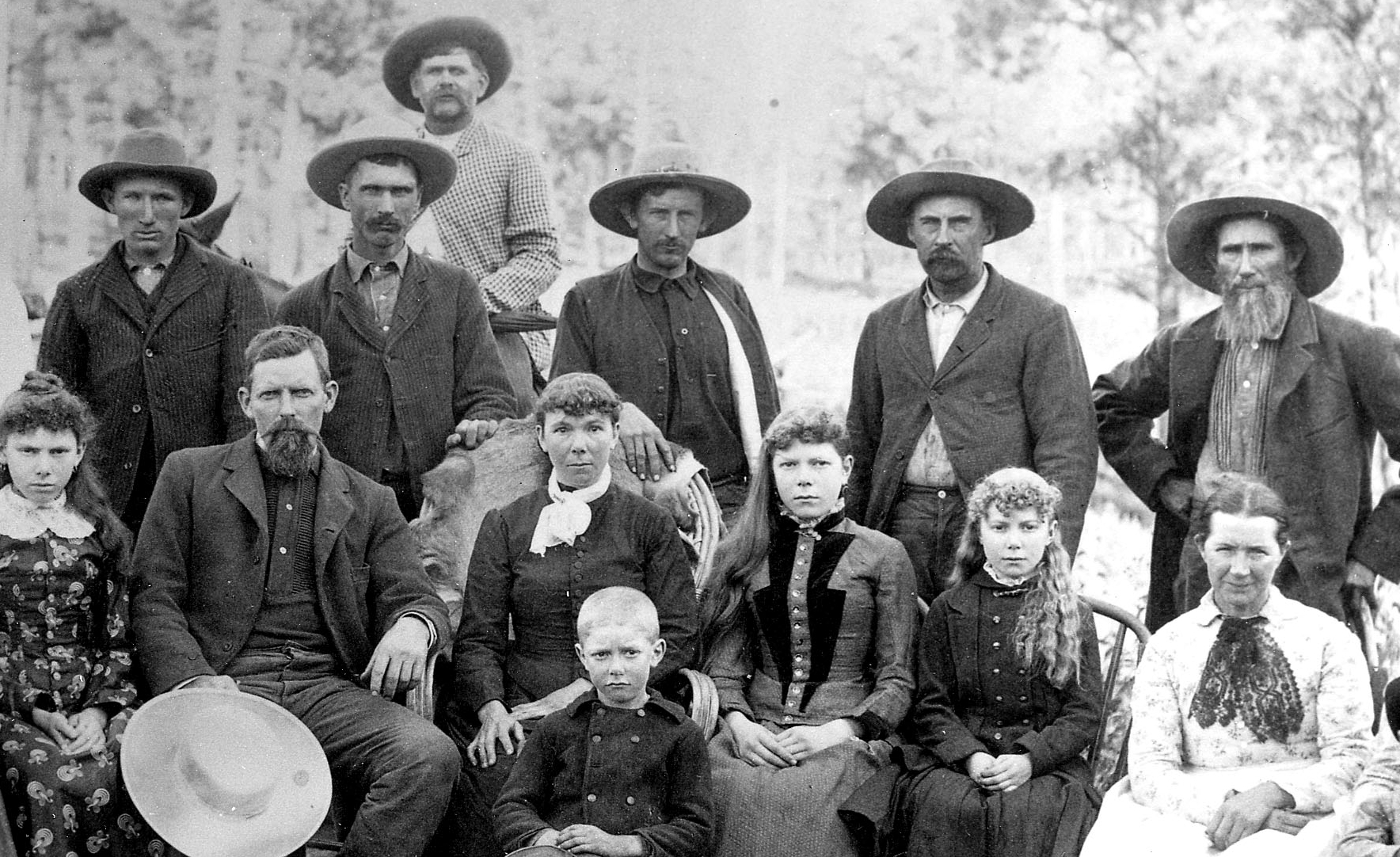
Lee Breece, seated second from left; Adam Breece, standing second from left; B. L. Breece, standing right
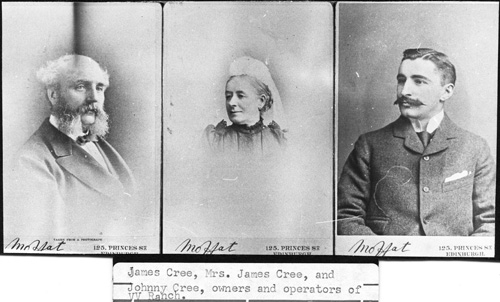
James Cree, left; Agnes Cree, center; James Edward Cree, right (James Edward was incorrectly captioned as Johnny in the original.)

The Crees’ Townhouse, 34 Royal Terrace, Edinburgh, Scotland (2011 photo)
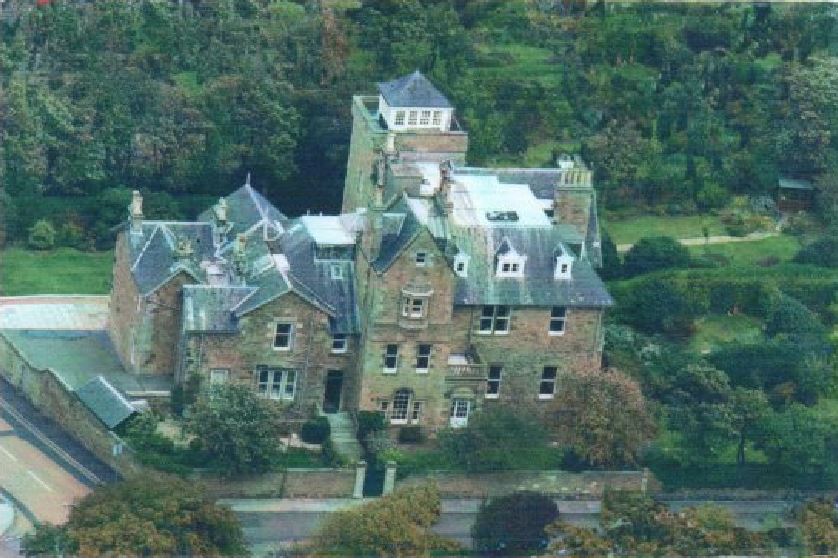
“Tusculum”, North Berwick, Scotland (2010 photo)
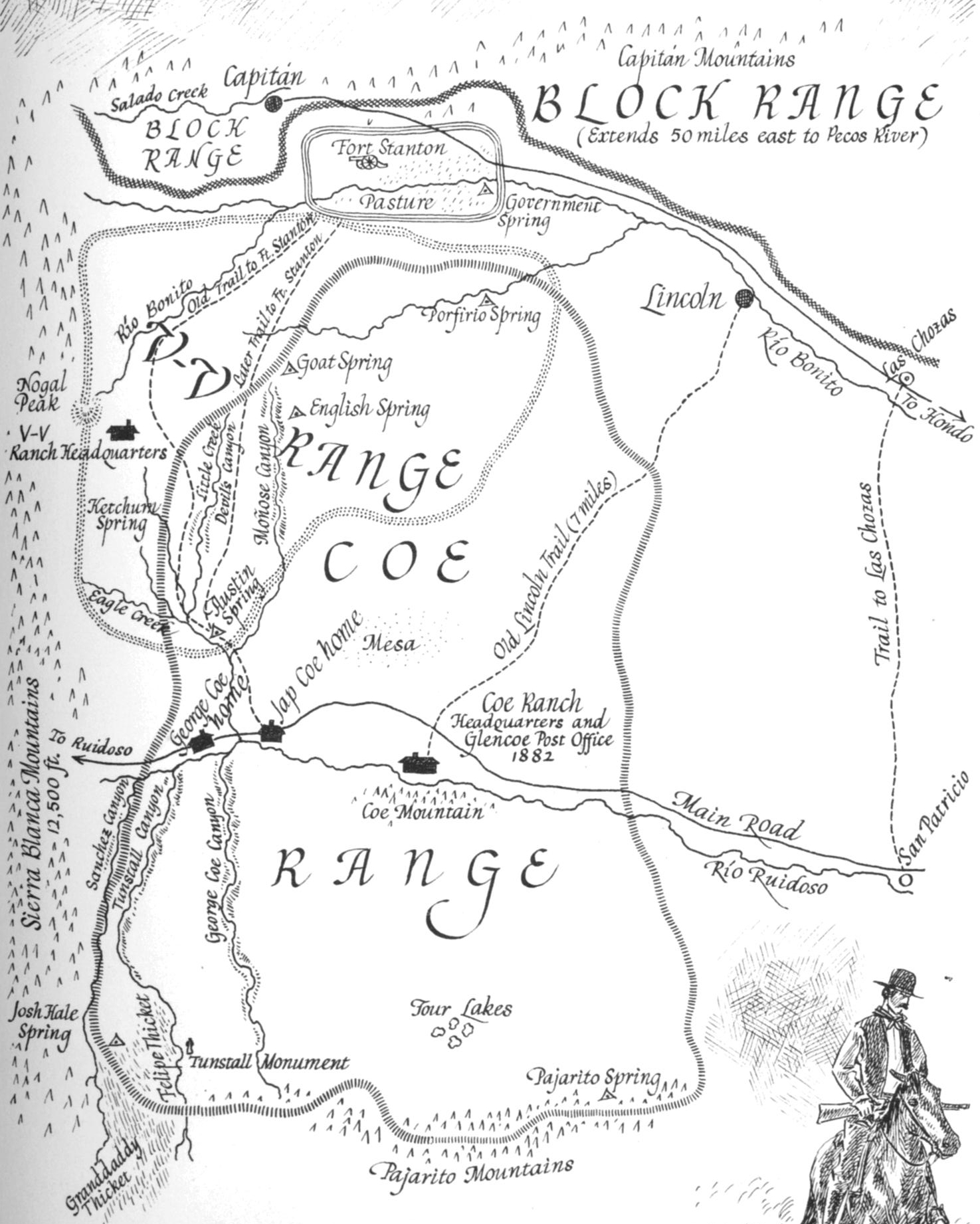
from Coe, Wilbur, and Peter Hurd, Ranch on the Ruidoso: The Story of a Pioneer Family in New Mexico, 1871-1968.
Just how big was the V V? Eve Ball, in an interview with Metz, said that it encompassed “At least 200 sections...”16 That is, 200 square miles or 128,000 acres! Likewise, a map in the book Ranch on the Ruidoso shows it extending from the Sierra Blanca in the west to around Glencoe in the east, and from Eagle Creek in the south to Fort Stanton in the north.17 But there are obvious distortions in this map, so the author decided to pin down its exact location by researching deeds. He found 53 tracts before giving up. They aren’t, in general, contiguous. Total acreage is approximately 2,60018 – roughly 4 sections, with an average tract size of around 50 acres.
What accounts for this big difference? Ball provided the explanation:
“[The ranchers] just bought the waterhole and used the rest of the land... if you owned the waterhole, you could... station a guard at the waterhole and not let any cattle come in but yours to drink…”19
By purchasing 4 sections, they were able to control 200 or more for grazing purposes. Government land didn’t require grazing permits at the time, so he who controlled the water controlled all the land around it.
The Crees, Agnes in particular, were fond of the Angus breed, which originated in Scotland. They thought that by breeding them with native (“Mexican”) cattle, an improved herd would result. This busy year of 1885 ended with Kirby setting sail to Scotland to purchase Angus bulls. He’s quoted as saying they will cost $600 each delivered ($90,000 for 150 bulls). An 1898 Texas price the author found was $42.50! This comparison probably isn’t entirely fair because of the difference in time and place, but at least it suggests that the Crees were paying dearly for these bulls.
The cattle drive: 1886
“They brought 150 Aberdeen Angus bulls from Scotland... to Corpus Christi and shipped them to San Antonio, New Mexico by train. Then they drove them overland to the ranch. Well, these old Mexican cattle could travel 15 or 16 miles a day; they're so long-legged and skinny. But these new cattle had probably never walked over a quarter of a mile in their lives; it was a job to get them to the ranch. They lost a lot of them on the way; it was dry and they just couldn't walk.”20
The above account is none too sympathetic to the bulls. A descendant of the Breeces is more charitable:
“[The bulls] had spent about 2 months in confinement on board ship and train, I'm sure they had tender hoof and atrophied muscles, no wonder they couldn't walk if they didn't put them on pasture to recover for a month before moving them.”21
The Ball account is the fullest account of the cattle drive which the author has been able to locate; unfortunately, it is incomplete and, at best, 3rd-hand. Ball got it from Edith L. Coe-Boyce-Rigsby (Wilbur Coe’s sister), whom she interviewed in 1958-9 for a book (never published). Edith, born in 1896, couldn’t possibly have been on the drive, so she must have gotten the story from some other(s).
Sophie Poe lived in the area when the drive took place, but nevertheless her account, written some 50 years after the event, seems totally implausible:
“As the cattle could not be driven from the railroad out to the ranch, they had them transported in wagons from Socorro...”22 (emphasis mine)
The idea of the V V sending, say, 75 wagons, each of which had to have a driver and be drawn by at least 2 oxen, horses, or mules, to transport the bulls strains credibility to the breaking point.
Nevertheless, the problem of getting the bulls across the infamous Jornada del Muerto intrigued the author, so he decided to approach it a different way: How, in general, were goods and people transported through that area? Examination of several contemporary maps was disappointing; none shows a plausible route.

Four major obstacles would have faced anyone trying to drive cattle from the Socorro/San Antonio area to Alto. There were 2 mountain ranges to be crossed or avoided. The first, the Oscuras, is much the less difficult of the two. An elevation gain/loss of only around 600 feet suffices to cross them. To cross the Sierra Blanca, however, would have required climbing to around 9000 feet above sea level, a vertical gain of around 4000 feet. Not only were there no roads crossing the Sierra Blanca in 1886, but there are none to this day.23 This range had to be avoided.
The third obstacle is the Carrizozo lava flow, AKA Valley of Fires, AKA malpais. While the lava was fairly smooth when it initially flowed, cracks later opened up, some of which are just wide enough to catch an unwary animal’s hoof and break its leg. Lava tubes, cave-like structures under the surface of the flow, collapsed, leaving arroyos full of rock rubble. It was said in 1870 that “... only Indians afoot dared go [across the malpais]...”24
The final, and perhaps most difficult, obstacle is the lack of water. The author undertook to locate all the natural sources of water in the area, using the Geographic Names Information System http://geonames.usgs.gov/. He found only one between the Rio Grande and the Oscuras (~30 miles), and that one was only convenient if traveling from Socorro. Water sources become a bit more frequent east of the Oscuras.
If one assumes that there were 12 cowboys on the drive, they would need a remuda of at least 96 horses25. A cowboy the author knows estimates that each animal would require around 5 gallons of water per day26. Therefore, it would take around 1230 gallons of water per day just for the livestock: a nontrivial amount for a spring to provide.
|
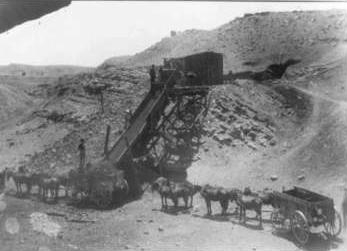
The route followed by the Ozanne Stage Line, which ran from the railroad to White Oaks starting in 1886, surmounts 3 out of 4 of the above obstacles.27 28 First, the starting point of San Antonio (espoused by Ball/Coe) and that of Socorro (espoused by Poe) are both called into question. At the time, the AT&SF railroad had a bridge across the Rio Grande and a spur line running about 13 miles east from San Antonio to the coal-mining town of Carthage. Taking the bulls on the train to Carthage would have saved driving the herd across the Rio (sometimes hazardous as one traveler noted seeing oxen skulls stuck in the mud there), and saved about a day’s drive. The V V was well-financed, so could've easily afforded the slightly higher railroad fare.
From Carthage, there is no natural water source for around 25 miles. But a well had been drilled (Miera Well29 – 90 feet deep!), probably for the very reason of lack of natural water, and it was only 9 miles away. From there, they could have headed directly for Borrego Spring, the first natural water source, in the Oscuras, but it was 14 miles away. A safer course of action would have been to do as the stage did: go to Hansonburg, a silver, copper, and lead mining camp, 9.5 miles away, thence to Borrego, 8 miles from Hansonburg.
From Borrego, the cowboys would have encountered the 2 longest stretches between waterholes in the entire trip: 12.5 miles to Red Canyon Spring, then another 12.5 miles to Willow Springs. Just before reaching Willow, they had to cross the malpais, but they could have done it there, because the merchants of White Oaks had built a road across one of the malpais’ narrowest points – only about 0.5 miles wide. People called it Upper Crossing.30
From Willow, the route turns northeast to avoid the Sierra Blanca. Eight miles from Willow lies Anchor Spring, near present-day Carrizozo (but Carrizozo didn’t exist then). At that point they had detoured sufficiently north to avoid the Sierra Blanca, so could turn east: 11 miles to Vera Cruz Spring, near the present-day junction of US 380 and NM 37.
From Vera Cruz, it was 3.2 miles to the town of Nogal, and from there 6.5 miles to Bonito City, a silver-mining town now submerged beneath the waters of Bonito Lake. From Bonito, it was 4.5 miles to V V headquarters in Alto. Probably the last stretch from Vera Cruz to Alto was accomplished in less than two days. The route detailed above would have been about 85 miles long, and would have taken about 9 days. Since this route is hypothetical, it might be supposed that there are many other possible routes. However, when one takes into account the 4 obstacles mentioned, there are few other possibilities, particularly before reaching the eastern slopes of the Sierra Blanca.
This cattle drive happened in March, so water would not have been as much an issue as it would have been in, say, July. If the bulls could have walked as much as 12.5 miles per day, they could have made it. But, how many did? The answer awaits the discovery of a better account.
The cowboys were finished with their first major cattle drive, but more were on the way. 54 more bulls and 17 heifers destined for the V V are mentioned in an April 4 newspaper article as being quarantined in Boston.31
Trouble: 1886-1891
The first inkling of trouble on the V V to be reported publicly appeared on April 24, 1886:
We learn that P. F. Garrett has, of his volition, abandoned his contract as Superintendent of the Angus Cattle Co., and is going to confine his attention to his ranch at Roswell.32
A fuller public account of this event had to wait for years:
[Kirby] sailed and was gone for months.33 Shortly before his return, he cabled to Garrett to discharge [a cowboy who had offended him], which wasn’t done... Garrett was discharged. A $6,000-a-year salary was paid, however... 34
Garrett had been manager of the V V for about 8 months; coincidentally, about the same amount of time he captained the LS Rangers.
After Garrett's firing, Kirby took the management reins himself.35 Around 3 months later, he flexed his management muscle by firing everyone else.36
By 1890, the elder Cree had enough of Kirby. He wrote 2 letters to his son James E., who was at that time in the “Osage Nation” (Arkansas, Missouri, Kansas, or Oklahoma), presumably on a business trip. The first of these was written on June 9.37 He first states that “more than half of the Capital of the Firm had been lost.” Later, he says that “the Firm” was created by a contract between Kirby and his son. He refers to clauses in the contract: “Clause 15th” apparently specified when the value of the Firm is to be calculated, “Clause 23” evidently states that disputes are to be settled by arbitration, not lawsuits. He states “...I think you are justified in dissolving the Firm in terms of Clause 20th.” Later, he states “I am the principal Creditor of the Firm”, and wishes to have his debt secured under clauses 10 and 21. He orders his son to “get Col. Fountain’s38 opinion on this and execute any deed he may recommend.” By implication he wanted his son to return home the long way, via Las Cruces. It’s clear that he wants to oust Kirby in such a way that Kirby cannot get his hands on any of the firm’s assets.
A follow-up letter written 9 days later39 mostly reiterated and expanded on the June 9 letter.
It is worthwhile to reexamine prior allegations made about the relationship between Kirby and Cree in the light of more knowledge. It seems plausible that Kirby was Cree’s agent for the land purchases. Poe says:
…all [Kirby] was capable of doing was...signing checks on the Cree funds.40
The article “Fateful Facts Furnished” says:
[Kirby] never put a dollar of his own money into the ranch...41
Also, the elder Cree, in the June 9 letter, makes the point that his son, not himself, is Kirby’s business partner, although by that time Cree wants to take a strong hand in dissolving the business. It had been clear for years that somebody was excessively tolerant of Kirby’s shenanigans. It has been assumed that Cree was that person, but the contract raises the possibility that it was his son. The younger Cree, 10 years Kirby’s junior, could well have admired the military adventures of the older man42, and wanted to be his friend and business partner. The elder Cree could have been humoring his son.
Was Kirby Cree’s adopted son? The author has found no evidence supporting this allegation, and the way in which Cree subsequently got rid of Kirby argues against it. Was Kirby Cree’s prospective son-in-law? “Fateful Facts Furnished” says so, and says that the partnership was Cree’s attempt to remedy his daughter’s rejection. Margaret, Cree’s only daughter, was around 2 years younger than Kirby, so the ages fit. But she had married in 1876, 9 years before Kirby came to New Mexico. For him to have still been pining for her seems a bit of a stretch. And by going to New Mexico, he put himself much further from her, as she remained in Scotland.
All things considered, the most plausible scenario is that Kirby met the Crees through his romance with Margaret. The romance ended, but the affection the younger Cree developed for Kirby continued for years afterward.
The plan to oust Kirby had been put in motion. Six months later, Kirby left, but he didn’t go quietly. When next we hear of him, he is in Denver giving an interview to the Rocky Mountain Daily News.43 He says that he has visited all the countries in the world in his early life, and traveled with Stanley and Burton in Africa. He states that he intends to transport 40,000 head of cattle by rail from New Mexico to British Columbia. He is quoted as saying he has “sunk $300,000 in New Mexico and must get out or collapse at an early day.” He says that coyotes, bad Mexicans, and bad laws have assisted materially in doing him up.
This interview quickly made its way to New Mexico, where it prompted a quick response.44 The writer of “A Bovine Baron” had never heard of Kirby, so merely repeated some of what the News article said, and implied skepticism about Kirby’s statements:
THE OPTIC suggests to the captain that he build a [rail]road for himself; for this would only be in keeping with the remainder of his remarkable exploits.
“A Bovine Baron” prompted response from some person(s) who knew more about Kirby’s dealings on the V V, leading first to the article “Fateful Facts Furnished”, then the letter to the editor by “Hawthorne”. These 2 items illuminated Kirby’s tenure on the V V in a way which should have been embarrassing to him, had he ever read them.
No cattle were ever transported to BC; most likely Kirby owned none to transport. The only thing in “To Lead An Exodus” which came to pass was that he did live in BC (Vancouver) for a time.
It may be assumed that the Crees were glad to get rid of Kirby. However, their joy was to be short-lived. On May 18, 1891, the elder James Cree died at age 74, and was buried near Cedar Creek in present-day Ruidoso. Now, the younger James was really in charge.
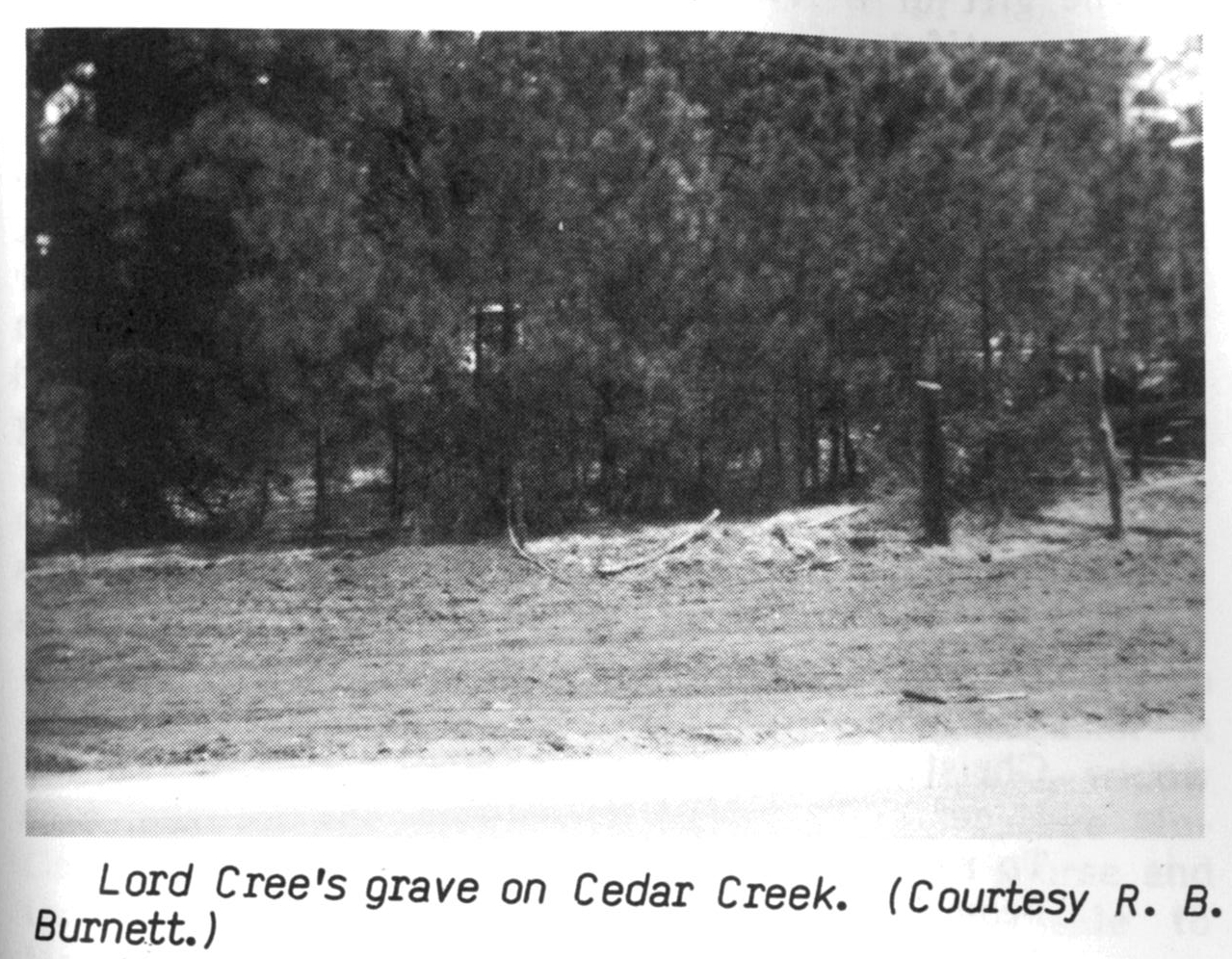
James Cree's grave near Cedar Creek, (present-day) Ruidoso, NM, 1891-1908
Epilogue: 1893-1939
Lack of space precludes detailing the remaining years of the V V, so they will merely be sketched out here:
1893 – James Edward Cree marries Eliza Mabel Fleming in Scotland.
1894 – James’ first child Irene Mabel Napier Cree is born in New Mexico.
1894 – James hires Andrew Hudspeth (a future Chief Justice of the New Mexico Supreme Court) as a bookkeeper.
1894-6 – James collaborates with Albert Jennings Fountain to stop cattle rustling, leading to Fountain’s disappearance and presumed murder.
1897 – James’ son Charles Mortimer Cree is born in Scotland.
1906 – James has 17 brands registered in New Mexico, more than most if not all of the other ranchers in the state.
1908 – James's widowed mother Agnes moves back to Scotland bringing her husband's (the elder James) remains.
1915 – Agnes Cree dies in Edinburgh, age 83.
1926-7 (ca.) – James’ son Charles Mortimer Cree takes over the V V.
1929 – James Cree dies in Scotland, age 64.
1939 – Charles Cree sells the ranch to A. H. Kudner.
Notes
- Poe, Sophie A., and Eugene Cunningham. 1981. Buckboard days. Albuquerque: University of New Mexico Press, pp. 216-217.
- Poe, Buckboard days, p. 221.
- Reily, Nellie Gray, [Interview with Nellie B. Reily by Edith L. Crawford]. New Mexico, 1938. Manuscript/Mixed Material. Retrieved from the Library of Congress, https://www.loc.gov/item/wpalh001162/. (Accessed November 03, 2016.)
- Poe, Buckboard days, pp. 233-255.
- Metz, Leon Claire. 1973. Pat Garrett: the story of a western lawman. Norman, OK: University of Oklahoma Press. p. 136.
- Metz, Pat Garrett..., pp. 136-148.
- The author will refer to this area as Alto, even though the name didn’t officially exist until a post office was established there in 1901.
- The Lincoln County leader. (White Oaks, Lincoln County, NM.), 06 June 1885 p. 4. Retrieved from the Library of Congress,
- Poe, Buckboard days, p. 231.
- Metz, Pat Garrett...p. 145.
- “Fateful Facts Furnished”, Las Vegas daily optic. (Las Vegas, NM.), 12 Dec 1890.
- “Hawthorne” (prob. pseud.), [letter to editor], Las Vegas daily optic, 15 Dec 1890.
- His annual salary as Lincoln County sheriff in 1880-1882 was $200!
- UK Census 1881, Vol 685-2 Enum Dist 14, p. 20.
- Golden era. (Lincoln, NM.), 15 Oct. 1885 p. 2. Retrieved from the Library of Congress,
- Ball, Eve, [Interview with Eve Ball by Leon C. Metz], 1969, "Interview no. 21," Institute of Oral History, University of Texas at El Paso, p. 1.
- Coe, Wilbur, and Peter Hurd. 1968. Ranch on the Ruidoso: the story of a pioneer family in New Mexico, 1871-1968. New York: Knopf. p. iii.
- Not much more than Kirby’s initial purchases.
- Ball, Eve, [Interview…], p. 1.
- Ball, Eve, [Interview…], p. 3.
- Clark, Donna, [personal communication], 9 March 2015.
- Poe, Buckboard days, p. 231.
- Roads would not have been necessary for the livestock, but they undoubtedly had at least one important wagon with them: the chuck wagon.
- Wallace, Andrew, “Duty in the District of New Mexico: A Military Memoir,” New Mexico historical review 50, no. 3 (1975), p. 249.
- Estimates of the numbers of cowboys and horses come from Klasner, Lily, John Simpson Chisum, and Eve Ball. 1988. My girlhood among outlaws. Tucson, Ariz: University of Arizona Press, p. 294.
- Mundy, Print, [personal communication], 9 November 2016.
- Hart, Robert L., “She’ll Be Comin’ Round the Mountain: The Ozanne Stage to White Oaks and Lincoln, 1886-1895,” Southern New Mexico historical review III, no. 1 (1996), pp. 28-40.
- Eidenbach, Peter L., and Robert L. Hart, 1997, A number of things: Baldy Russell, Estey City, & the Ozanne Stage: historic ranching and mining on the U.S. Army White Sands Missile Range, New Mexico. Tularosa, NM.: Human Systems Research, Inc., pp. 135-162.
- Sometimes called “Montoya’s Well” by Eidenbach and Hart
- “Lower Crossing” had been built in 1870 by Colonel August V. Kautz, the commander of Fort Stanton, but it would have made their drive longer.
- Las Vegas daily gazette. ([Las Vegas, NM.]), 04 April 1886 p. 2. Retrieved from the Library of Congress,
- Lincoln County leader, 24 April 1886, p. 4.
- This was probably when he went to buy Angus cattle.
- “Hawthorne”, [letter to editor], Las Vegas daily optic, 15 Dec 1890.
- “Fateful Facts Furnished”, Las Vegas daily optic, 12 Dec 1890.
- The St. Johns herald. (St. Johns, Apache County, Arizona Territory [Ariz.]), 22 July 1886 p. 1. Retrieved from the Library of Congress.
- Cree, James, [Letter to James E. Cree, June 9, 1890], Charles M. and James E. Cree Papers, 1885-1950 and undated, Southwest Collection/Special Collections Library, Texas Tech University, Lubbock, Texas.
- Albert Jennings Fountain (1838-1896), of Las Cruces, was the attorney for the Southeastern New Mexico Stock Growers’ Association.
- Cree, James, [Letter to James E. Cree, June 18, 1890], Charles M. and James E. Cree Papers, 1885-1950 and undated, Southwest Collection/Special Collections Library, Texas Tech University, Lubbock, Texas.
- Poe, Buckboard days, p. 231.
- “Fateful Facts Furnished”, Las Vegas daily optic, 12 Dec 1890.
- Eve Ball said that he was "...a phony.”, but he was not a total phony. Lack of space precludes detailing his adventures here.
- “To Lead An Exodus”, Rocky Mountain Daily News (Denver, CO), 2 Dec 1890.
- “A Bovine Baron”, Las Vegas daily optic. (Las Vegas, NM.), 6 Dec 1890.
- Poe, Buckboard days, p. 221.