|
1801. May 2d, 5th.
An illegitimate child not entitled under the description of a child in a will; though the testator knew the state of the family, viz. several illegitimate and no legitimate children.
A bequest to a particular description of persons at a particular time vests in persons answering the description at that time exclusively.
Therefore an annuity being bequeathed over upon the death of the annuitant to the eldest child of A., there being at the death no child, an afterborn child is not entitled.
|
JOHN CREE by his will required, that all his estates, real and personal, should be converted into money after his decease, and placed at interest upon solid land security (mortgage); and the issue, and profits thereof annually to be disposed of in manner following: Imprimis, To his daughter Eleanor Cree (afterwards Eleanor Davis) the annual sum of 300l. during her life, to be paid half yearly; to James Cree 100l. per annum, for his life, payable half yearly; to James M'Mahon 200l. per annum, for his life, payable half yearly; and in case of his death his widow Ann M'Mahon to receive during her life 100l. per annum, half yearly. The testator then gave the following annuities, also payable half yearly; to Miss Elizabeth Francis 300l. per annum for life; to John Godfrey, Esq. 100l. per annum for life; to John Byrn 100l. per annum for life; with remainder to his daughter Caroline Byrn for life; to Jane Harris 60l. per annum; to John Parsons 40l. per annum; to revert to his daughter after his death; to James Archdekin 100l. per annum; and 100l. per annum to David Godfrey. The will then proceeded thus:
"And the first annuity of the great ones that drops in I will and desire may devolve upon the eldest child male or female for * life and in two half yearly payments of William Harwood; and in case the interest of my property produces a sum more than sufficient to answer the payment of the several annuities herein specified then the proportion of the annuities to increase; but if less to diminish in the like due proportion excepting the annuities of Miss Jane Harris and my butler John Parsons. And I hereby will and require that as the said annuities drop in their amount is to go to the increase of the annuities of the survivors, so to increase to the last survivor who shall hold the same during life: Jane Harris and John Parsons excepted. And when the said annuitants are all dead the whole and sole property devolve without any condition upon the heirs male of Philip Francis Esq. of St. James's Square, and in default of issue to female branch of the said family of Philip Francis Esq. taking the name and arms of Cree"
The testator died in 1791 [sic - should be 1795] soon after the execution of the will. David Godfrey died upon the 15th of May, and Eleanor Davis upon the 24th of June, 1798. The eldest daughter of William Harwood claimed the annuity of 300l. a year; which claim was disallowed on the ground, that she was a natural daughter. An exception was taken on her part to the report. It was proved, that the testator was very intimate with Harwood and his family; and knew, he had no legitimate child; and that this daughter and all his other children were treated hy him as his children (56). The parents of these children married several years after the testator's death. That exception was disallowed.
Another claim was afterwards set up to the same annuity by Clara Elizabeth Harwood, as the only legitimate child; having been born after the marriage. Her claim being also disallowed by the Master, she took an exception to the report; which came on to be argued.
Another question was made at the bar, but not determined: supposing her claim well founded, whether she was entitled to the annuity of 300l. a-year or 100l. a-year.
Mr. Romilly and Mr. Benyon in support of the Exception. The cases of Baldwin v. Karver (57), Heathe v. Heathe (58), and others of that class, are distinguished from this; as in those there were two classes of children; and then there can be no doubt the intention is in favour of all those children, who shall be alive at the time the contingency happens; for if the distribution is not confined to some particular period, it cannot be ascertained, who are to take, until after the deaths of the parents of all the persons to take: which leads to this inconvenience; that none of the persons, for whom the fund is intended, may receive any benefit from it. But this is confined to one person. The testator knowing, the parent was unmarried, must have had in contemplation the birth of a child in future. He had in contemplation the survivorship of these annuitants, until the last of them should be dead. In that event only he gives it over. Weld v. Bradbury (59 )
is an authority in support of this exception; though certainly different in its circumstances. There are no words in this will requiring the object of this bequest to be alive at the death of the testator, or of the annuitant; who dropt. If she had been alive at the death of the annuitant, she would have been entitled within many modern cases; the last of which is Middleton v. Messenger (60). This is not like those cases, where the distribution is to be among all the children in esse at the death of the tenant for life. This is not confined to the period of any life; but might last during several lives. In that respect it differs from Congreve v. Congreve (61).
Mr. Alexander and Mr. Cox, for the surviving Annuitants.
The claim of the illegitimate child was rejected; because no intention was sufficiently expressed in her favour. Phrases occur in this will, singularly denoting, that the testator intended the person to take to be alive at the death of the annuitant. Upon the whole will there can be no doubt, that if this child had not been born for ten years, the existing annuitants would have enjoyed the annuities dropping in increase of their own annuities. It must be contended, in order to maintain this exception, that, even if the ultimate limitation had taken effect, the whole interest should go back upon the birth of a child, after all these events were past. Upon the old cases no one could take, who was not in existence at the date of the will (62). The construction, that afterwards prevailed, was, that those must be intended, who came into existence before the death of the testator. Afterwards every one was let in, who answered the description, before the fund became disposable in some way. In the ordinary case, a disposition to the children at the age of 21, all, who are in esse, before the eldest attains 21, are let in (63): in the case of a tenant for life, all, who are in esse before the death of the tenant in life (64). That is the general rule; and in order
to extend it a distinct intention to suspend the vesting must
be shewn. Ellison v. Airey (65) has been recognized in
almost every subsequent case. In substance there must be
a legatee in being; unless an intention to the contrary is
clearly shewn; in order to avoid suspending. The direction
for the devolution of the annuity implies, that there is a person in being, upon whom it is to devolve; and is not applicable
to a suspension for 15 or 20 years. The most explicit declaration is necessary to produce the effect of calling it back.
The great difference upon this question as to marriage settlements is, that all the children are the objects of those provisions. The case cited from Vernon is a loose note upon
very different circumstances, and inconsistent with the subsequent authorities. With respect to the distinction from the
other cases, a dispute between two different classes of persons,
that is the case upon this will: 1st, there is a particular class
of persons described: 2dly, there are the other annuitants.
Upon what principle can Ellison v. Airey and the other cases
be distinguished from this? If all the children were intended,
the construction of the Court confining it was directly against
the intention. The question must rest entirely upon the principle originally laid down in that case, and invariably acted
upon since. It is said, upon this construction no person might
take the benefit of this: but this is a case, in which there
might or might not be a child of Harwood existing at the
time the annuity falls in. Can the construction be determined
by the event? There certainly might be a person existing
at the time; which clearly distinguishes it from those cases,
in which of necessity there could be no person existing at
the time. The express disposition of the annuity at the
moment it falls in to the surviving annuitants negatives all
idea of suspension. But the general rule, admitted to be
the result of the authorities, is sufficient to over-rule this
exception.
Mr. Romilly, in Reply.
This case does not fall within the genei'al rule; and no
case is produced in circumstances like it. Taking the will and the facts as to the state of the family together, well known to the testator, he must have had the intention maintained by this exception. He must have intended a legitimate child, according to the decision upon the former exception. He was aware of the probability, that one of the annuities might soon fall in: so many annuities being given, and not to young people. It is impossible upon the will not to see the intention. He must have had in contemplation a period, that might be distant, and some person, of whom he knew nothing; which distinguishes this case from Congreve v. Congreve; where, if not confined, it must have extended to a time, when all the objects of bounty might be dead. Such a limitation as this clearly means only, that there shall be a person standing as the representative of that family at some distant period; having no view to particular persons. The argument would apply to every case of executory devise. In the famous case of Hopkins v. Hopkins (66) it might be said, it was unnatural to suppose, the testator intended it to devolve to the heir-at-law, until some person should come in esse: but no such argument prevailed; and what stronger reason is there against the suspension, in this case? We do not argue from the event: but it appears clearly, the testator must have known, if one of the annuitants had died the day after the execution of the will, there was no one to answer the description; and then there is nothing to shew he meant to confine it to the death of the annuitant, except the word "devolve:" but why is the devolution to be immediate in this instance more than in Hopkins v. Hopkins, or any other case? Ellison v. Airey is relied on only for the general doctrine. The case in Vernon is the only case, that has any resemblance in circumstances; the disposition being to the children of persons, who had none at the time : whereas in the others the dispute was between two classes of children: there being some at the date of the will. Who are the annuitants meant in the clause of survivorship? Not the persons named as such only, but those expressly named and the person described as the child of Harwood; and then there is no inconsistency in supposing,
that a child born at any time might take the annuity. It is not material to contend, whether it was disposed of in the mean time. I think not: but it would fall into the residue.
________
The Master of the Rolls (after stating the case).
Upon the former exception by the eldest of the illegitimate children of Harwood, a daughter, who claimed as the person intended by the description of "the eldest child," it was contended, that though by the determinations, that have taken place, no one can claim under the description of a child but such as can claim as a legitimate child (67), yet upon the circumstances appearing in evidence, the situation of Harwood's family not unknown to the testator, a family of illegitimate children, recognised by their father as his children, that daughter was entitled to the annuity falling in, as persona designata in this will. Upon that exception I was of opinion, there was not sufficient to entitle an illegitimate child to claim; for, whatever the real intention of the testator might be, and though it could hardly be supposed, he had not some children then existing in his contemplation, yet as the words are "the eldest child," such persons only could be intended, who could entitle themselves as children by the strict rule of law; and no illegitimate child can claim under such a description, unless particularly pointed out by the testator, and manifestly and incontrovertibly intended, though in point of law not standing in that character. Notwithstanding the evidence of the testator's knowledge of the situation of this family, I did not think, that entitled these children to claim under this description (68). Therefore I over-rule that exception.
Another claim is now brought forward by another daughter of Harwood by the same mother; who being born after the marriage of her parents has certainly a right to claim as the eldest child; provided, the testator did not intend upon this will a disposition at a given period. With respect to this the first consideration is, whether upon this will enough appears
to prove, the testator intended, that immediately upon his death these annuities should take place: whether the whole produce of his property, though portioned out into annuities, was not manifestly intended to be divided among all these annuitants in different proportions, according to the degree of their annuities; and I am of opinion, that it is neither more nor less than a division of the whole interest of his fortune, that might arise during the lives of any of the persons there named, be it more or less, in proportion to their annuities, except the two given to Harris and Parsons, which I lay totally out of the case upon this question; with the qualification, that if any die, there should be a substitution in the room of the first dying. I am not under the necessity of saying, which are to be considered the great annuities. I consider all as the great annuities for the purpose of entitling the child of Harwood to the first, that might fall in. In the view I have of this will it makes no difference, whether the right of survivorship and of substitution in favour of the person described as the eldest child of Harwood attached upon the first or the second of the annuities now vacant.
The next question is, whether, as upon the death of the first annuitant there was no person answering that description living, that annuity was to be divided among the survivors, or to be suspended, and the profits to accumulate, to see, whether any such person should come in esse. It is clearly established by De Visme v. Mello(69), and many other cases, that, where the testator gives any legacy or benefit to any person, not as persona designata, but under a qualification and description at any particular time, the person answering; that description at that time, is the person to claim; and if there are any persons answering the description, they are not to wait to see, whether any other persons shall come in esse .but it is to be divided among those capable of taking, when, by the tenor of the will the testator intended the property to vest in possession (70). That case was much considered by Lord Thurlow; and seems to have settled the law upon the subject. The first question is, whether it is clear, the testator meant, any given set of persons should take at any given time: if so, it is clear, all persons answering that description, whether
born before or afterwards, shall take: but if there are no such persons, it shall not suspend the rights of others: but they shall take; as if no such persons were substituted. Before that case this point was not quite so clear: Singleton v. Singleton and Ayton v. Ayton (71). Where the gift is to all the children of A. at twenty-one, if there is no estate for life, it will vest in all the children coming into existence, until one attains the age of twenty-one. Then that one has a right to claim a share; admitting into participation all the children then existing; so, if it is to a person for life, and after the death of that person then to the children of A. the intention is marked; that until the death of the person entitled for life no interest vests. When that person dies,' the question arises, whether there are then any persons answering that description; if so, they take, without waiting to see, whether any others will come in esse, answering the description. If it is given over, in the event that there are no children, and there are no children at that period, the person, to whom it is given over, takes. It is clear, this testator meant these annuities to commence at his death: and that each annuitant should receive a proportionable share of his fortune, with benefit of survivorship and right of accruer, subject upon the death of the first annuitant to the substitution of the eldest child of Harwood. Upon the death therefore of the first annuitant, unless there was some one, who had a right of substitution in the room of that person, (and there was no such person,) it was to go among the survivors. The person substituted, viz. the eldest child of Harwood, not having been then in existence, cannot now claim. That construction is much fortified by the manner, in which it is given over; for it is perfectly clear, he meant the persons, to whom, it is given over under the description of the heirs of Francis, to take upon the death of the persons, to whom it was first given over. If the construction contended for is to prevail, those persons, supposing all the other annuitants, claiming by survivorship, were dead, must wait not only the death of the survivor, but also the death of Harwood; for during his life there would be a possibility, that a child might be born: who upon that construction might say, he was the survivor. That would be
quite contrary to the words and what must be supposed the intention. Much stress was laid upon the event of the former exception; that not having in his contemplation the illegitimate children, or at least not having described them sufficiently, he might mean a child hereafter to be born. But that does not follow: that, because by incorrect words he had not described his intention, so as to enable the Court to determine in favour of an illegitimate child, I am on that account to make a different determination on this point. It appears, he must have intended a person existing at the time any of these annuitants dropt; or to borrow an expression from the case of Thellusson v. Woodford(72), of which we have heard so much lately, all the candles must be burning together. That must be the intention; and he could not mean, that there might be a person in embryo, to come out after the deaths of all the annuitants.
Upon these grounds and upon the construction of the will being of opinion, that the interest in these annuities was intended to vest in possession, and unless there was some person to claim under the substitution, the whole interest would survive to the others until the death of the last survivor, and that there was no person to answer that description at the time the event took place, I think, the Master was right in rejecting this claim; and the exception must be over-ruled.
I shall not decide the question, which of these are to be considered the great annuities.
________
(56) Cartwright v. Vawdry,
(57) Cowp. 309.
(58) 2 Atk. 121. See cases collected in Mr Sander's note, 122.
(59) 2 Vern. 705.
(60) Ante, Vol. V, 136.
(61) 3 Bro. C. C. 531.
(62) Northey v. Strange, 1 P. Will. 340.
(63) Andrews v. Partington, 3 Bro. C. C 401. Ante, Preterit v. Long, Vol. II, 690. Boste v. Pratt, III, 730.
(64) Spencer v. Bullock, ante, Vol. II, 687.
(65) 1 Vet. 111. In Hill v. Chapman, ante, Vol. I, 405. Lord Thurlow says that case went upon a refinement, but cannot now be shaken. See 408, and the note.
(66) 1 Vern. 268. For. 44. 1 Ath. 581. 1 I'm. 268. Mr. Butler's note, 231. Co, Lit. 271 b.
(67) Cartwright v. Vawdry, ante, Vol. V, 530, and the note, 534.
(88) Ratcliffe v. Buckley, post, Vol. X, 105.
(69) 1 Bro. C. C. 537
(70) See Hutcheson v. Jones, 2 Madd. 124.
(71) 1 Bio. C. C. 542, note.
(72) Ante, Vol. IV, 227.
|
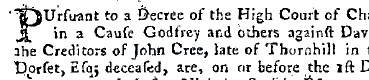 PUrsuant to a Decree of the High Court of Chancery made in a Cause Godfrey and others against Davis and others, the Creditors of John Cree, late of Thornhill in the County of Dorset, Esq; deceased, are, on or before the 1st Day of March next, to come in before Nicholas Smith, Esq; one of the Masters of the said Court, at his Chambers in Southampoton-Buildings, Chancery-Lane, London, and prove their debts, or in Default thereof they will be peremptorily excluded the Benefit of the said Decree.