|

THE POLITICAL HISTORY OF IRELAND is more relevant to genealogy than may be expected by non-Irish researchers. For example Philip Robinson describes the Plantation of Ulster as “one of the most politically significant mass migrations to have taken place in Western Europe since medieval times.” A careful reading of sources such as his Plantation of Ulster (Gill & Macmillan, Dublin 1984) and Robert Kee's Ireland - A History (London 1980) may well suggest profitable lines of genealogical research for descendants of Ulster Crees.
Our attention is focused on the earliest successful plantation, a privately organised Protestant settlement mainly of lowland Scots in north-east Down in 1607, which pre-dates the official Ulster Plantations. It was led by two Scottish adventurers, Hugh Montgomery and James Hamilton of Ayrshire, with some involvement of the “gullible lord of Upper Clandeboye” as Robinson describes Con McNeill McBrian O'Neill. Robert Kee points out that the settlement “prospered rapidly and became the bridgehead by which, for the rest of the century and beyond, individual Scottish settlers flocked to Northern Ireland.”
|

Robinson states, “The area within the Great Ards which Hugh Montgomery obtained lay to the south, that is the countryside around Comber, Newtownards and Greyabbey at the head of Strangford Lough. Hamilton's estates were to the north of these, along the southern shore of Belfast Lough from Holywood to Bangor and Groomsport. Through these grants to Montgomery and Hamilton, foundations were laid for the most concentrated and substantial colony of British to arrive in Ulster during the first half of the seventeenth century.”
This is precisely the area where the Cree surname in Ulster occurred. Until the 19th Century, Cree families in the North of Ireland were entirely located in a group of seven contiguous parishes in County Down centred on the northern part of the Ards Peninsula. There are Cree records from every parish shown in red on the parish map on the left - Bangor, Donaghadee, Inishargy, Ballywalter, Ballyhalbert, Greyabbey and Newtownards.
Trevor Cree has found and extracted the earliest Cree records from the County Down muster rolls. These suggest there were half a dozen adult male Crees in Ireland by 1642 and imply a Cree migration in the earliest years of the Hamilton-Montgomery Settlement from 1607 onwards. They are:
- William Crea at Bangor in 1630,
[Source: PRONI D1759/3C/1 Muster Roll for the County of Down (1630)]
and the following, all in 1642:
- George Gree
- James Gre
- Patrick Gre
- Robert Gre
- Alexander Crea at Groomsport
- Robert Cray at Killaleagh (parish 46 on the map),
[Source: Linen Hall Library, Belfast: Irish Regiments. 1642. Exch. Commonwealth Papers. Bundle 120.]
Gree and Gre are almost certainly mistranscriptions or misprints of Cree and Cre - there is no such surname as Gre or Gree as far as we know, whereas Cree is a known surname in County Down from other sources. It is very easy to confuse a capital G with a C is early handwriting.
Assuming that only men over 21 could take part in a muster, these records show Cree individuals who could easily have been sons of a migrant who was part of the initial wave of the Montgomery-Hamilton settlement in the years immediately after 1607. Indeed one of the list might have been that migrant. Or they might have been a family group of migrants - this often happened in these plantations to a potentially foreign country. (There is also an isolated record from the 1663 Hearth Tax roll showing a John Cree at Magilligan in County Londonderry. There are no further records from that part of the Province.)
More significantly, we have also (in 2008) located a Crie gravestone from Donaghadee parish dated 1674, showing that a James Crie of Ballybuttle (near Millisle) was born at least as early as the 1640s.
|
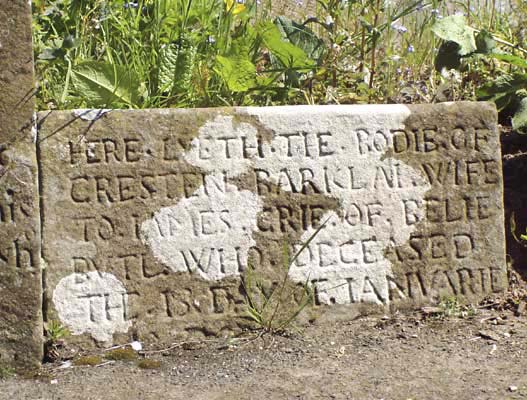
Here lyeth the bodie of Cresten Barklai wife to Iames Crie of Beliebvtl [Ballybuttle near Millisle] who deceased the 13 day of Ianvarie Anno. Dom. 1674 and of her age the 27 year. Also hear is ...
(the spellings of Crie, bodie and Ianuarie are very significant)
It is likely that all the Cree individuals we have mentioned are related to each other. They are quite numerous by the time we have records (mainly gravestones) showing family relationships. The total number is then consistent with a common ancestor some time in the period 1600 to 1650.
We now come to a group of five individuals who are of the same generation and just one generation later that James Crie. One of them is known only from his date of death. The birth years of the other four are known, and range from about 1675 to 1692. These are the people, with perhaps one or two others as yet unknown to us, that we must look to be the ancestors of the County Down Crees:
- David Criee (sic) of Ballycopeland who died in 1725. He left a will which we know about only from the Wills Index, the will itself having not survived;
- John Cree who was buried at Templepatrick, near Millisle, in Donaghadee parish in 1726 aged 50 and was therefore born in 1675 or 1676;
- James Cree of Donaghadee who died in 1790 at the age of 107! The fact alone has ensured that his life did not go unrecorded as it was mentioned in the Belfast Newsletter. He was therefore born in 1682 or 1283;
- Esther Cree who was buried in the graveyard of Movilla Abbey at Newtownards in 1766. She was 76 when she died and so was born in 1689 or 1690;
- Robert Cree who was also buried at Movilla Abbey. He died in 1756 aged 63, As he died in December it is likely that he was born in 1693. A further inscription on the same gravestone refers to a "James Cree late of Ballycastle who Departed this life May 24 1800 Aged 74 Years." It seems likely therefore that Robert was James's father and also lived at Ballycastle, a small townland, then in Newtownards parish on its boundary with Greyabbey parish to the south.
We can say that it is almost certain that the Cree families of County Down are descended from Scottish Cree ancestors. These are the main reasons for making this statement:
- In the 17th and 18th Centuries (but not at all before 1630) the Cree name in the North of Ireland is found entirely within the area of the Hamilton-Montgomery Plantation of the northern Ards Pensinsula of County Down;
- Cree (with spelling variations Cre, Crey and Crie) is a fairly common surname in Perthshire, Scotland, from the sixteenth century onwards and is known there as early as 1459;
- The earliest Cree gravestone in County Down (that of the wife of James Cree of Ballybuttle) has an inscription that has distictivvely Scots features, such as the spelling of Crie, bodie and Ianuarie, and the use by a woman of her maiden surname after her marriage;
- Cree families in County Down were Protestants (almost all Presbyterian in fact) and intermarried exclusively with families bearing lowland Scottish surnames (for example Esther Cree, above, married a Montgomery (a Hugh Montgomery indeed!) and there was also a Cree-Hamilton marriage around 1750);
- The period when the earliest Cree individuals lived in County Down is compatible with a migration from Scotland as part of the Hamilton-Mongomery Plantation;
- DNA testing has shown an almost perfect match between the YDNA of Trevor Cree, who is descended from a County Down Cree line, and Fred Cree, who is descended from a Perthshire Scottish line, providing definitive proof that the County Down and Perthshire lines are related;
The size of the Cree population in County Down at that time was compatible with descent from a single early migrant from Scotland or from two or three such Cree migrants, within the first seventy years of the 1607 Hamilton-Montgomery Settlement. It pre-dates the earliest known Cree families in Ayrshire (a 1721 marriage) and we should thus look to Perthshire as a likely origin of the County Down Crees.
Emigration from Ireland
The Scottish Presbyterian settlers' descendants became disenchanted with the actions of the British government and with their relationship to the (Anglican) Church of Ireland and the largely English-descent establishment there. From the mid-eighteenth century onwards many chose to migrate to the USA. At least six Cree individuals moved, either as individuals or taking their families, from County Down to settle in western Pennsylvania where many northern Irish Presbyterians settled. YDNA testing has shown that all or most if these six Cree families were closely related to each other. In fact they included two pairs of brothers. Their migration to the USA around 1770 is discussed in the page on migration to the USA.
Of the five Cree individuals born in the last quarter of the seventeenth century, John Cree became the progenitor of a line that thrived in the vicinity of Millisle well into the 20th Century, while Robert Cree had children who founded branch dynasties in Ballybarnes (in the western edge of Newtownards parish) and Ballycastle (on the southern edge). Esther married a Hugh Montgomery and settled near to Ballybarnes and there were subseqently two more Cree-Montgomery marriages amongst her and Robert's descendants. We refer to this branch as the Newtownards branch. It was still represented in Ballybarnes as late as 1941, while sub-branches moved, some to nearby locations such as Lisburn, Bangor, Whitespots and Portavo, and others further afield to Taralga (New South Wales) and Melbourne and Majorca (Victoria)
Scotland to Ireland to the USA
YDNA testing has shown that the Newtownards branch is definitely related to all the Scottish Cree lines that have been tested so far (March 2015). It has also shown that most of the the American Cree lines are closely related to each other but not related to either the Newtownards branch of Robert Cree or to any Scottish Cree line. They could be descended from others of Robert's contemporaries such as the Millisle line or from James Cree of Donaghadee or from David Cree. If these in turn acquired their Cree name from Scottish Cree lines there must have been a non-paternal event at some time well before their migration to the USA. In other words the Cree name was passed on to a male who did not inherit the Scottish male Cree genes.
Research continues
In recent years substantial progress has been made in unravelling the genealogy of the County Down Cree lines. The explorations continue and many uncertainties remain.