It has often been claimed that the names Cree and McRae are linked. The American Professor Black in his Surnames of Scotland states that Cree is:
A surname in Ayrshire and Glasgow. More probably a shortening of (Ma)crae than from the place name Cree.
(Black, George F. The Surnames of Scotland: Their Origins, Meanings, and History New York: (reprinted) 1946)
Researches by members of the Cree Family History Society have shown that Black was wrong on both counts. The earliest Cree record in the West of Scotland is in 1694 in Glasgow; the earliest in Ayrshire is in 1721. There are strong grounds for believing that Cree families in Ayrshire and Glasgow were from Perthshire, where the name Cree occurs in 1459 as John of Cre. The most likely origin is from a place name such as Crieff (Perthshire) or Creich (Fife), both about 25 kilometres from Perth.
The name McRae (earlier spelled McRa) is that of some Highland families who lived mainly around Beauly, Inverness-shire. In the 14th Century, some McRa families moved to an area around Dornie and Inverinate on the shores of Lochalsh and Loch Duich in Wester Ross. They were closely associated with, and vassals of, the powerful Mackenzie of Seaforth who granted their chiefs the hereditary title of Constables of Castle Eileen Donan.
The name McRae does not derive from a traditional patronymic as many Mac- names do, but is Gaelic for "son of grace". Dropping the Mc would in fact give the name Rae (not Crae). As well as the Highland McRae there is a similar name McCrea (with many spelling variants such as McGrath) which is quite common in Ayrshire and in County Antrim, Ireland. This is often regarded as the same as McRae. We have not researched this in any depth, but the geographic separation, together with the addition capital C after the Mac, suggests it is a different name. There is no evidence that this has associations with Cree either.
We do know of one occasion when a Mackree changed his name to Cree. Paradoxically this occurred in Engalnd - at Bolsover, Derbyshire - between the baptism of James, son of Alexander Mackree, in 1644 and his marriage as James Cree in 1687. There would seem to be little doubt, from both his names, that Alexander Mackree was a Scotsman, possibly a mercenary in the Royalist army that was based in Bolsover during the English Civil War. We have no indication of where in Scotland he might have come from. (See History of the name Cree in Derbyshire)
There may be other instances of a change from McCree/McRae to Cree. We have not found any. Although Perth was the main gateway to the Highlands, even in the late Middle Ages, the burgesses of Perth were Lowlanders who spoke and wrote Scots, a dialect of English. They would not have been Gaelic speakers even in mediaeval times. They only rarely found anyone amongst them with a Mac- prefix to their name, and in any case McRae was not common in the adjacent parts of the Highlands. In short there seems no evidence to suggest that the Cree families in Perth derived their name from McRae.
The genealogy of many Highland families has long been clouded by the process of "tartanisation", the invention of a panoply of Clan accoutrements such as a tartan, a castle or two, a list of surnames accepted as variants or septs, and sometimes an uncritical acceptance, or (dare one say?) invention, of clan genealogies and legends of the clan's origins. I am not claiming that all such genealogies and histories are untrue. Some are based on historically verified facts. Some are clearly based on the best evidence that is available for the periods to which they relate. That evidence is sometimes more than is available for Lowland or English families. On the other hand many are not well founded.
The modern Clan MacRae lists the surname Cree as one of those it accepts as a variant or sept of the Clan. Based on the evidence that we have accumulated through research into the Cree surname, there seems no historical justification for this. I have also seen a claim (on a tartan seller's web site) that Cree is a sept of the Clan Stewart of Galloway.
Let us not allow such confusions to affect the genealogies of Lowland names such as Cree. I would take a strong pinch of salt with any suggestion that there has ever been a historical Clan Cree, a Cree tartan (prior to the twentieth century) or an "ancient castle" as seat of such a clan, even if the Lord Lyon himself were to make a grant of arms on that basis. If the said castle were to be on the banks of the River Cree it would be shown just to be a bit of harmless fun, as our extensive researches have failed to turn up any Cree families in that part of Scotland. Even those in South Ayrshire didn't arrive there much before 1800. And they came from Perthshire! (A tartan of the Stewart Earls of Galloway was worn by some members of the Cree line of Sprotbrough from 1910.)
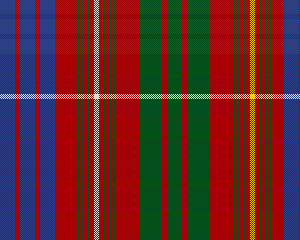
Any Cree tartan you may find is the invention of an astute, modern-day tartan manufacturer. Most are based on a design of 1981 as is the one shown below. No self-respecting Cree in, say the seventeenth century, would have been seen dead in a kilt, although in later centuries one cannot be sure; the process of tartanisation to which I refer has quite a long history in itself and is tied up with the romanticism of the Prince in the Heather and Flora MacDonald and the enthusiasm for all things Scottish of King George IV, with the active encouragement of Sir Walter Scott. Charles Edward Stuart attended a ball held in his honour by the Jacobite ladies of Perth during his "visit" there in 1745. Perhaps there was a Cree who donned a kilt for the occasion...?
The reality of the '45 was that, after the Battle of Culloden, Patrick Crie, Provost of Perth, wrote to King George and to the Duke of Cumberland to give thanks for deliverance from "a numerous army of Rebels and Traitors."
See also:
Spelling variations of the Scottish surname Cree
Early Cree families in Scotland
 Tartan of MacRae of Inverinate.
It was a MacRae of Inverinate who in 1909 made an unsuccessful claim to be the legal Chief of the Clan MacRae.
 Cree tartan of 1981 from House of Tartan (now listed there under McRae).
© Copyright HOUSE of TARTAN 1996 - 2005