Francis and Rose Cree
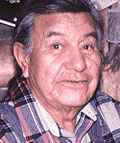 Francis Cree was born in 1920 or 1921. He died on 27 June 2007 aged 86.
The ancestry of Francis Cree is not known to us but he and Rose are described as "two of the handful of full-blooded Ojibwes still left." He and Rose were married for 64 years. She said in an interview, "I had seven girls, seven boys. Now these young ones, my son's kids, my daughter's kids they have kids, then their children have kids. It's four generations anyway." I guess there are plenty of Crees to carry on this line!
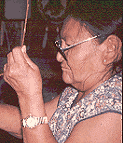 Rose Cree was born Mindimooye Ginew Ikwe in on 21 July 1921 to Thomas Machipiness and Pearl Little Boy. She died on 13th January 2004 aged 82.
Rose attended boarding school in Fort Totten, N.D. At 18, she returned home to the Turtle Mountains. She had more than 130 grandchildren and great-grandchildren and five great-great-grandchildren. She had many adopted children. The Manitoba Chiefs web site (no longer available) states that, "The Cree, Ojibway and Ojibway-Cree are part of the largest linguistic grouping in North America - the Algonquian peoples."
In 1984 Francis and Rose Cree were honoured with the North Dakota Governor's Award for the Arts. The citation is no longer available. It is almost identical to another citation when they were awarded National Heritage Fellowships in 2002 (See National Endowment for the Arts). It stated:
Rose and Francis Cree are highly respected Ojibwe elders on the Turtle Mountain Indian Reservation in north central North Dakota. As is the case with many elders, their lives reflect the intersection of artistic skill, tribal knowledge, and cultural authority. The Crees collaborate in making willow baskets, both collecting the materials, while Francis makes the frames from ash and Rose weaves the willows. Both are also storytellers and keepers of Ojibwe cultural knowledge.
Francis is a singer, a spiritual leader, a carver of pipes, and a keeper of the ceremonial drum for the Dunseith community.
In addition, both Rose and Francis Cree teach young people in their community about Ojibwe culture through school programs. They mentor local youth and participate in the North Dakota apprenticeship program. In 1984, the Crees received the North Dakota Governor's Award for the Arts. The Crees set an important example, according to North Dakota folklorist Troyd Geist.
"We would like to see this humble, generous, and artistic couple recognized nationally not only for the quality of the artistic traditions they uphold but also for showing us that traditional art is not apart from other aspects of life, that it is a way of life."
Francis Cree died on 27 June 2007 aged 86. Sen. Kent Conrad, Democrat Senator for North Dakota, paid tribute to Francis Cree in the US Senate:
Mr. President, I want to pay tribute to a friend and distinguished North Dakotan, Francis Cree, who passed away on June 15 at the age of 86.
Francis Cree was a highly respected Ojibwe elder of the Turtle Mountain Band of Chippewa of North Dakota. He was the official pipe carrier for the tribe, a position of honor and leadership. He led the tribe as chairman in the 1960s and served several terms on tribal council. Francis spent countless hours teaching young people about Ojibwe culture and traditions. He was also a singer, a crafter and artist, a spiritual leader, a carver of pipes, and a keeper of the ceremonial drum for the Dunseith community. On November 8, 2001, we had the honor here in the Senate of being led in opening prayer by Francis. It was indeed a proud day for Francis and his family.
Francis was married to Rose Cree, herself a well-known artist who made beautiful willow baskets, several of which were featured at the Smithsonian's Festival of American Folk Life on The Mall here in our Nation's Capital.
The Crees collaborated on these baskets. Both collected the materials, while Francis made the frames from ash, and Rose wove the willows. In 2002, Francis and Rose received the National Endowment for the Arts National Heritage Fellowship, which recognizes the significant contributions of American folk artists.
Francis was a kind, humble, and generous man. He gave selflessly and never expected or wanted anything in return. Francis and Rose raised 14 children and opened their hearts and home to many more. They were also proud grandparents to more than 100 grandchildren and great-grandchildren and many, many great-great grandchildren. Each and every one of them is a reflection of Francis's caring and endearing spirit.
Mr. President, this is a tremendous loss for the Cree family, but it is also an incredible loss to North Dakota and the Nation. Francis's life and the legacy he leaves behind is truly an inspiration to us all.
(Extracted from The Congressional Record, "Honoring Francis Cree.")
Rose Cree died on 13th January 2004 aged 82. An obituary by Dorreen Yellow Bird, Grand Forks (ND) Herald Staff Writer, reads:
Native American people, particularly those of the Turtle Mountain Band of Chippewa, will remember Rose Machipiness Old Eagle Woman Cree -- Mindimooye Ginew Ikwe -- as a teacher, spiritual guide and a woman who always did for others.
The art world will remember Cree as one of the most skilled and talented red willow basket weavers in modern times.
Cree passed away Tuesday, surrounded by her children and grandchildren in her home in Dunseith, N.D. She was 82.
Cree and her husband Francis began weaving baskets back in 1965.
"See, this culture almost died out," she told the Herald in 1989. "I learned from my mother in 1936. We started picking it up again so it wouldn't be lost."
Francis Cree would cut willow branches and shape them to make frames. Rose Cree did the actual weaving using willow soaked in water. Fifteen years ago, they sold the baskets for $12 to $125. Today they're worth much more.
Some of her red willow baskets are displayed in the Smithsonian in New York City. Other willow baskets can be found in museums across the United States, Canada and other countries.
Please see the Discussion of the Cree surname in First Nations.